Senior / AI Product Manager · Hudson Valley (Kingston), NY
I design AI agents that know when to act, and when to stop and ask.
Product manager with 12 years cross-functional, including 5+ years in product management, across SaaS, healthcare, fintech and e-commerce. Lately: agentic AI products with human-in-the-loop guardrails.
Agentic AIMulti-agent systemsHuman-in-the-loopGuardrails & autonomy designLLM orchestration (ChatGPT, Grok Bot, Cursor)Source-grounded answersWebhooks & tool callingEvaluation designPRDs for AI productsNext.js / VercelGoogle Sheets API
I take products from discovery to launch: PRDs, roadmaps, requirements, analytics and go-to-market. Results include doubling SaaS activation at DemandJump, launching a 4.9/5-rated iOS app, generating $1.1M in B2C sales at Cambridge Audio, and helping secure $1M in program funding at Sanofi. Today I build agentic AI products myself, taking my own ideas from PRD to live, multi-agent systems with a human in the loop.
Featured case studies
Selected work
Case study 01 · Agentic AI
Hunter: guardrails for AI agents that act on your behalf
AI Product Builder · Independent product development · Oct 2025–present · Live demo · GitHub
Multi-agent systemsHuman-in-the-loopLLM orchestrationWebhooksNext.js / VercelGoogle Sheets API
Context
A senior job search is high-volume, repetitive work across several job boards. I designed Hunter, a multi-agent, multi-model system that finds, scores and applies to roles under rules I set, working qualified applications the way a sales team works qualified leads, plus a dashboard where I supervise the agents.
Problem
Full automation is fast, but it guesses, and a wrong answer on an application can't be taken back. Doing it all by hand is accurate but doesn't scale. The decision I owned: how much autonomy to give the agents, and where they must stop and ask.
My role
Product owner, from my own PRD to a live product. I defined each agent's job, the Match 75+ threshold, the stop-and-ask rules, the data model and the guardrails, and directed AI coding tools to build the dashboard.
Process & trade-offs
Multi-model by necessity. ZipRecruiter's recruiter-heavy 1-Click channel was worth automating, but its Cloudflare protection blocked ChatGPT, so I brought in Grok Bot, which runs on its own virtual computer, alongside ChatGPT and Cursor.
One Google Sheet as the system of record, not a database. Agents, dashboard and I share one workbook. Last write wins, acceptable with one operator and agents running in batches.
Questions become rows, not chat. When an agent hits a question my approved sources don't cover, it stops and logs it. I answer asynchronously; answers stay editable until locked.
Webhooks only signal. The server pings the right agent that an answer is ready, never sending the answer text. Keys stay server-side.
A pause switch in the sheet, checked by ZipRecruiter runs before starting.
Public demo mode with fictional data and no Google or webhook calls, so I can show the product without exposing anything real.
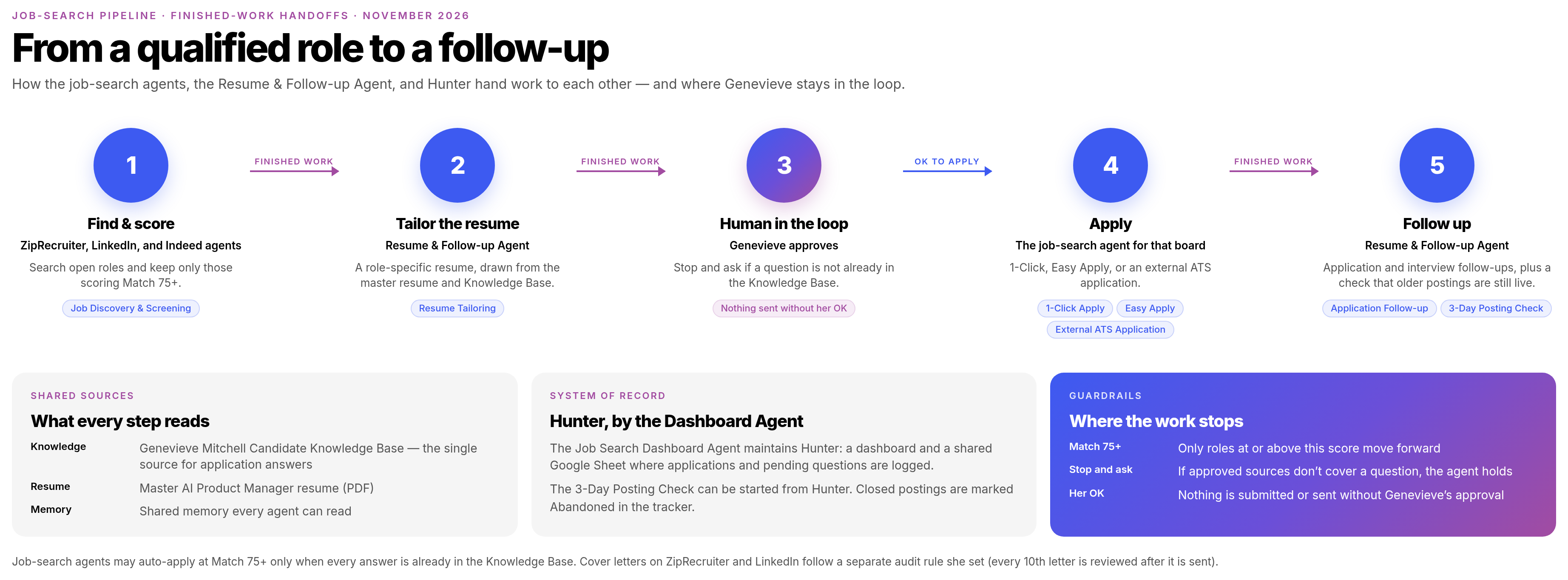
Tap to enlargeMy agents hand finished work to each other, from finding a qualified role through the follow-up. I stay in the loop at the approval step: if a question isn't already in my sources, they stop and ask, and nothing is submitted without my OK.
Outcome
~176qualified applications in 32 days (~5.5/day)
10recruiter interviews
~5.7%interview rate, ~2x the 3% benchmark¹
62automated regression tests across 9 files
In its first 32 days, Hunter submitted about 176 qualified applications (~5.5/day), leading to 10 recruiter interviews: a ~5.7% interview rate, about 2x the 3% application-to-interview rate Ashby and CareerPlug report for inbound applicants. It also brought 8 assessment invites, 6 recruiter submissions and a consulting agency interview. A 3-day check retires dead postings automatically.
I'd define a standard, LLM-agnostic data-handling spec for the tracker from day one, so any model (Grok Bot, Cursor, Claude, Gemini, ChatGPT, Muse) could write to it, diversifying usage and matching tasks to each agent's strengths. And I'd build evaluation earlier: a golden set of real application questions with approved answers to score agent accuracy.
Case study 02 · Zero to one
Keepsake: AI-assisted estate sales for first-time operators and families
AI Product Builder · Independent product development · 2025–present · ChatGPT MVP, Replit prototype, now in Lovable's She Builds cohort
Lovable She BuildsGenAI MVPPhoto-grounded LLMHuman-in-the-loopPricing decision supportPRD
Since November 10, 2026 I've been iterating on Keepsake in Lovable's She Builds cohort, an application-based program I was accepted into.
Keepsake's decision-support loop: photos in, a sourced price suggestion, a human decision, then the sale.
Context
Most families running an estate sale have never done one. They're often grieving, short on time, and unsure what anything is worth. Professional estate sale companies typically take a 35–40% commission, and 48% are one- or two-person teams (EstateSales.NET 2023 industry survey). Keepsake is an AI-assisted estate sale and liquidation app for those first-time solo operators and families, built to help them run a sale and get the most revenue from it.
Problem
In October–December 2025 I ran a full estate liquidation for a family friend, my first. The goal I set with the family was $5K. The decision I owned: how to price, stage and sell hundreds of items without professional tools or experience, what to sell, donate or keep, and how to design a system that would help me do that well.
My role
I ran the sale end to end and designed the tool I ran it with: a photo-grounded ChatGPT Project, used with Google Sheets, Excel and Google Photos, for inventory, pricing guidance and sale-day operations. I made the keep, sell and donate calls myself, using decision rules I worked out with the LLM. After the sale I wrote a PRD with 22 functional requirements and a data model, then a one-prompt Replit prototype. I'm now rebuilding Keepsake in Lovable from that PRD and a Rebuild Spec I compiled from the ChatGPT project on November 12, 2026.
Process & trade-offs
Chat-first MVP instead of building an app first, so I could test the idea on a real sale with real stakes in weeks. The path has been a ChatGPT Project with Google Sheets, Excel and Google Photos, then a Replit prototype, then Lovable.
Photo-grounded cataloging. I uploaded photos room by room, and the assistant drafted identification, description, condition, fair market value, low and high estimates, and a starting price. I cataloged 406 items this way, and I checked items over $100 against local comps.
A pricing system that keeps fair market value separate from list price. I named four tiers — Price-to-Sell, Standard, Premium and Rare — and used a markdown schedule. Items under $100 went into group posts; items $100 and up got their own Facebook Marketplace listings.
Sell, donate, or keep, with a family claim step. The family claimed items from a shared photo album by a deadline before anything went to market.
Sale operations around the catalog: Facebook listing copy, flyers, a cash and Zelle transaction log, family revenue updates, and a bulk-buyer offer with a 10% courtesy discount.
I caught the model's failure modes and designed the PRD around them. It invented comps, claimed work was still processing when it wasn't, let labels drift, and missed or misidentified items. The PRD keeps a human approving AI output before it's saved, and treats a suggested value as unverified until it has a source.
Outcome
122%of the $5K revenue goal
"Very impressed"The family and partners, on the process, the scale one person handled, and the results
The sale brought in $6,096 in estate sale revenue against a $5K goal, 22% over target. I cataloged 406 items. The family I ran it for and several partners told me they were "very impressed" with the process I built, the scale one person was able to handle, and the results. I also got positive feedback from local bulk antique buyers, customers, and partners, including a junk removal company that also runs estate sales. A one-prompt Replit prototype followed, and I'm now rebuilding Keepsake on Lovable from the PRD and Rebuild Spec.
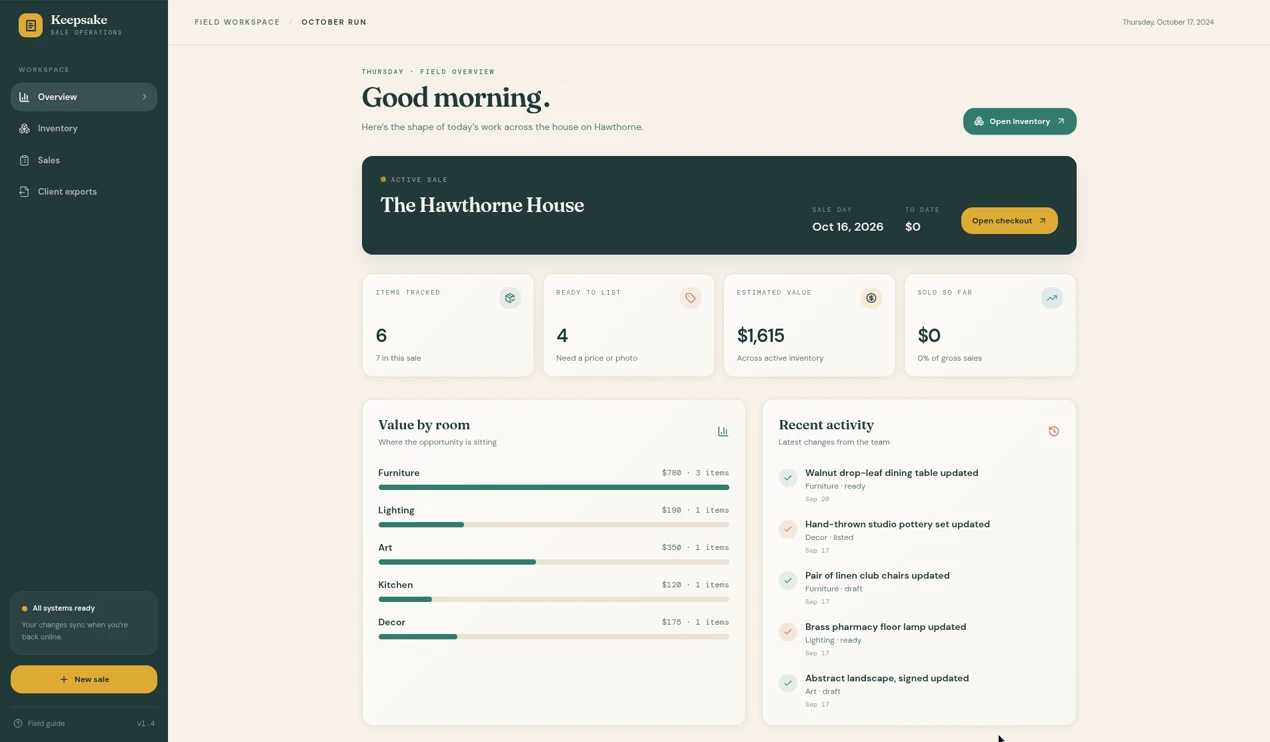
Replit first pass: sale overview with value by room. A one-prompt prototype, shown with demo data.
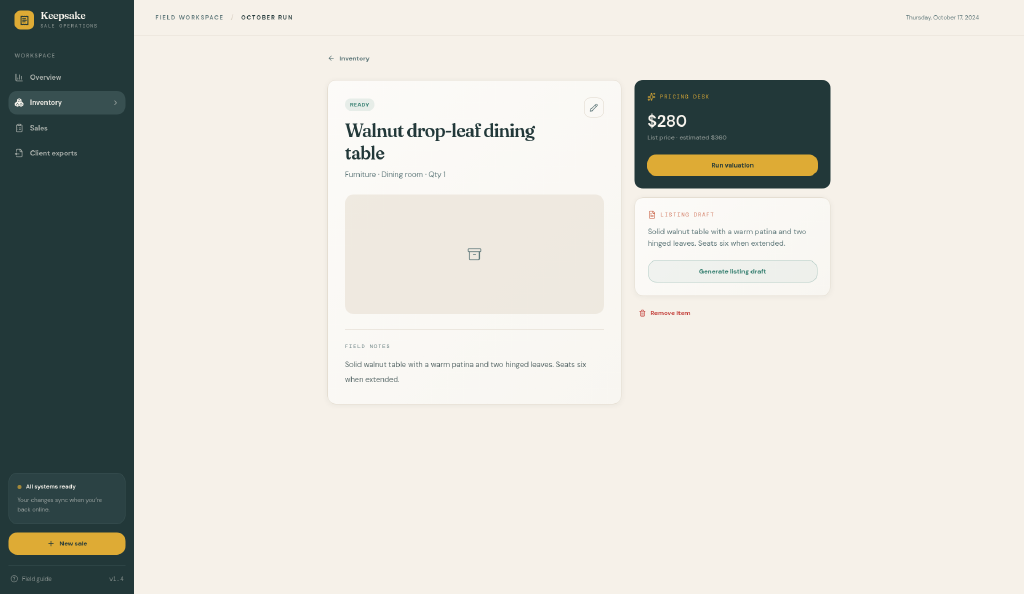
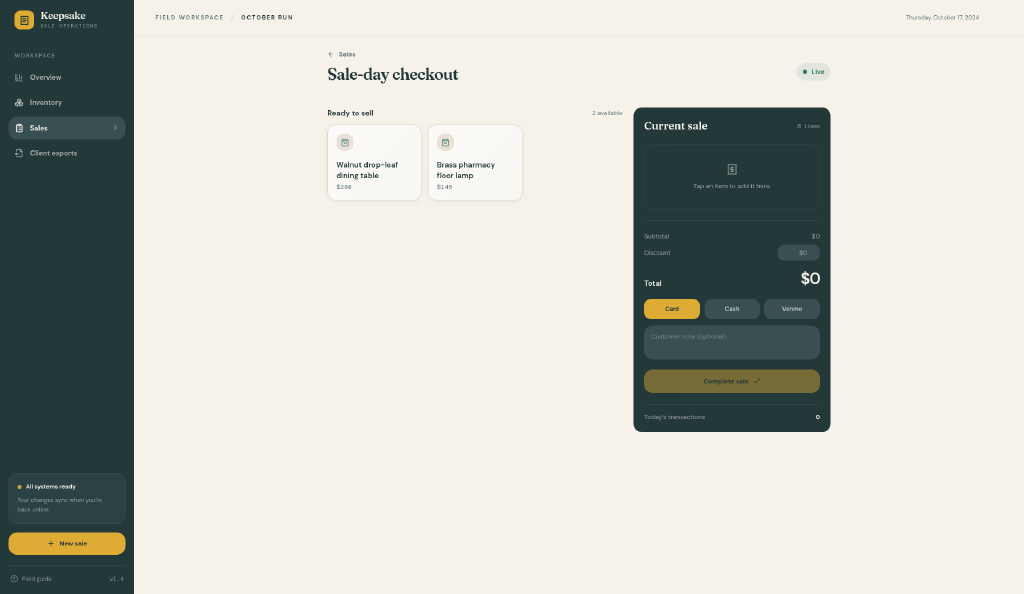
Item page with a pricing desk and AI listing draft.Sale-day checkout.
Next: the Lovable version is in progress through the She Builds cohort. I'm building it from the PRD and Rebuild Spec, and it hasn't been generated yet.
Learning
The model was useful for first drafts and less trustworthy as a source of truth. I'd put a human approval step on every AI output before it's saved, and I'd treat a suggested price or comp as unverified until it has a source, from day one — instead of discovering mid-sale that the model could invent comps, claim it was still processing, let labels drift, or miss items.
Case study 03 · Product operations
One10: standing up product operations so core-versus-custom decisions were repeatable
Technical Product Manager, One10 · Aug 2023–Feb 2024
Product operationsGap analysisBuild vs buy vs partnerChange managementConfluencePRDs
The intake path I set up. Every request went through a gap analysis that forced a core-versus-custom call, then a one-pager or PRD, then the roadmap.
Context
One10 is an incentives and recognition company. Its SaaS platform, PerformX, ran mostly as custom instances: all but two clients were on legacy, one-off builds. Sales and delivery kept bringing in RFP and contract requests that had to be estimated and staffed. I joined as Technical Product Manager on a services-heavy product team that needed a more repeatable way to decide what belonged in the core platform and what should stay custom.
Problem
Every client request defaulted to custom work. Estimates were hard to compare, platform investment got buried under one-off builds, and there was no shared way to tell whether a request was already in an RFP or SOW, how confident the estimate was, or whether it should become a core feature. The decision I owned: how to stand up product operations so those core-versus-custom calls were explicit and repeatable, without pretending the business could stop doing custom work.
My role
I launched the Product team's Confluence workspace and product office hours, and I created the templates the team used to intake and document work: a gap-analysis template, a one-pager template, and a PRD template. I wrote most of the documents that came out of that system, including a build-buy-partner LMS vendor analysis, an executive summary recommending we deprioritize an API for Learning, a one-pager for migrating clients toward Core PerformX, and the Learn 'n' Earn V2 one-pager and PRD. I also co-owned the UX and algorithm overhaul of the core incentive platform, interviewing stakeholders so complex variable configuration could be inferred from user inputs instead of taught to enterprise admins.
Process & trade-offs
A shared gap-analysis template, not one-off spreadsheets. Each request was scored the same way: fixed versus custom, already in the RFP or SOW, estimate confidence, and a link to the Azure DevOps ticket. I ran four client RFPs and estimates through it.
Confluence as the system of record. I stood up the Product workspace and used one-pager and PRD templates so outcomes, workarounds, market context, and open questions lived in one place, not in slide decks and inboxes.
Product office hours so Sales, Product, and Operations had a regular place to bring requests into that process.
Build versus buy versus partner for learning. Customers wanted a more robust Learn 'n' Earn, so I evaluated 12 solutions on 60 criteria. The analysis did not find a partner that met what we needed. I wrote an executive summary recommending we deprioritize a proposed API for Learning relative to higher-priority 2024 work, including Promotion Setup Wizard V2, and keep selling the existing Learn 'n' Earn as-is until a better path was planned.
A path off legacy instances. I wrote a one-pager for migrating custom client instances onto Core PerformX, so future custom work would sit as extensions on a core platform rather than as one-off builds.
Change-management workshops to align 80+ stakeholders across Sales, Product, and Operations. The company recognized the process work with the 2023 ONE10 Process Innovation Award.
Outcome
4client RFPs and estimates run through the shared gap-analysis template
80+stakeholders aligned through change-management workshops
2023ONE10 Process Innovation Award
I left behind a shared Confluence workspace, a gap-analysis template already in use on live client estimates, one-pager and PRD templates, a documented build-buy-partner analysis, and a written recommendation to keep the product focused on core incentives work rather than a learning API. I also left a platform plan for moving legacy custom instances toward Core PerformX. The company recognized the process work with the 2023 ONE10 Process Innovation Award.
Learning
In a services-heavy product organization, the useful move is not to ban custom work. It is to make the core-versus-custom call explicit, with a confidence score and a record of whether the request was already sold. I would instrument the process itself from day one — time to estimate, and how often "custom" requests later landed in core — so the practice could prove its value, not just feel more organized.
Skills
What I bring
Agentic AIMulti-agent systemsHuman-in-the-loopGuardrails & autonomy designLLM orchestration (ChatGPT, Grok Bot, Cursor)Source-grounded answersWebhooks & tool callingEvaluation designPRDs for AI productsNext.js / VercelGoogle Sheets API